
Ecommerce brands have adopted AI at a pace few technologies have matched, but adoption and actual use aren’t the same thing. McKinsey and Stord’s 2026 research found that 89 percent of retailers have adopted generative AI in some form, yet only 7 percent have reached fully scaled deployment across their operations. That gap sits at the center of most brands’ AI strategy right now, and back-office data is one of the areas where it shows up most clearly.
Most stores that have adopted AI did so on the customer-facing side first: a chatbot, a recommendation engine, a personalized search bar. Fewer have touched the side of the business where an admin actually decides what to do with the revenue, stock, and order data those customer-facing tools generate. That imbalance is exactly what keeps a store stuck in the 89 percent column instead of the 7 percent.
OpenCart Back Office AI addresses that specific piece of the gap: the distance between having AI tools available somewhere in the business and actually using them for daily store decisions. An AI-powered back office setup for OpenCart closes that distance by putting a query interface directly where admins already work, rather than adding another dashboard to check separately from everything else.
Why OpenCart Back Office AI Is Becoming the Missing Piece in Most AI Adoption Stories
Most public conversation about AI in ecommerce focuses on the customer-facing side: product recommendations, conversational shopping, personalized search. Adobe Analytics recorded a 693 percent year-over-year increase in traffic from generative AI sources to US retail sites during the 2025 holiday season, and that traffic converted 31 percent higher than other channels, with revenue per visit up 254 percent compared to the year before.
Those numbers get repeated constantly, and for good reason. But they describe what’s happening on the way into a store, not what happens after that traffic converts into an order that needs fulfilling, a stock level that needs watching, or a customer pattern that needs understanding.
Back-office analytics rarely gets the same attention, even though it’s where a store owner actually acts on what customer-facing AI produces. A store that gains AI-driven traffic without a faster way to read what that traffic is doing to revenue, stock, and order patterns is capturing the upside without the ability to respond to it quickly. The customer-facing investment and the back-office capability need to move together, not one far ahead of the other.
From Reporting Function to Operational Layer: What’s Actually Changing
| Reporting-Era Analytics | Operational-Era Analytics |
| Revenue dashboards checked periodically | Profitability dashboards checked as decisions require |
| Monthly or weekly report cycles | Real-time queries answered on demand |
| A human analyst as the bottleneck | Plain-language self-serve for any admin |
| Fixed dashboard layouts | Conversational analytics that adapts to the question asked |
Coupler.io’s 2026 analytics trend research frames this shift directly: ecommerce analytics stopped being a reporting function and became an operational one, as AI reshuffled product discovery, third-party data became unreliable, and channel fragmentation made scattered data genuinely dangerous to rely on. That shift applies just as much to a mid-sized OpenCart store as it does to an enterprise retailer, even if the tooling looks different at each scale.
The practical difference shows up in how a question gets answered, not just how fast. A revenue dashboard tells an admin what happened last month. A profitability query, asked the moment a decision needs making, tells them what’s happening right now and what it’s likely to cost or earn if nothing changes. That difference is the entire distinction between reporting and operating.
How an OpenCart AI Reporting Extension Fits Into the Bigger Shift in Ecommerce Data
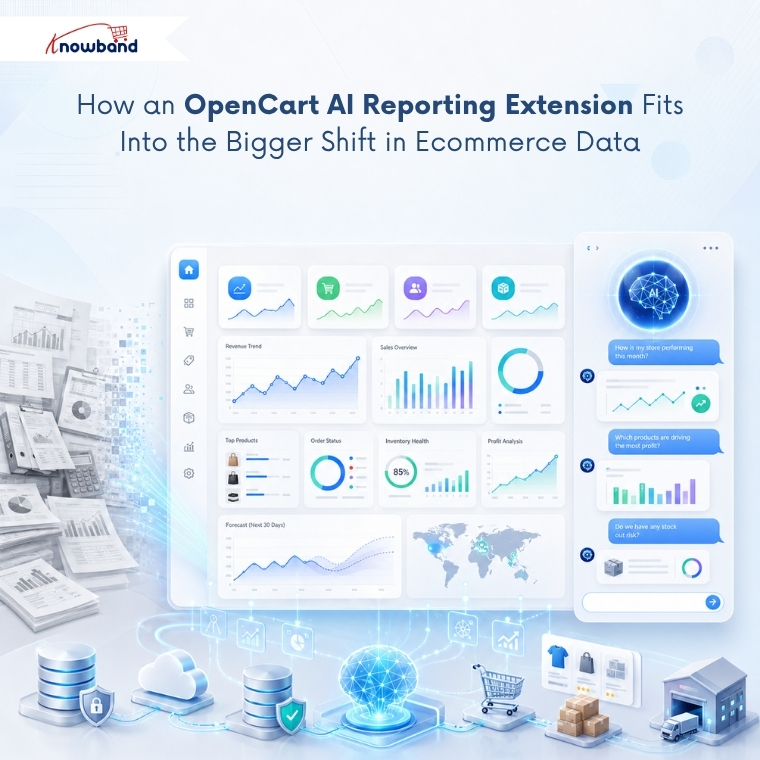
An OpenCart AI Reporting Extension built around this shift needs to answer questions on demand rather than waiting for a scheduled report cycle to surface them. That distinction matters more than it sounds: a monthly report catches a revenue dip a month late, while a query-based system catches it the day it happens, when there’s still time to adjust a promotion, a stock order, or an ad budget in response.
Machine-readable product data underpins this entire shift, since a natural-language analytics layer can only answer a question as well as the underlying data lets it. A reporting extension built on read-only database views, rather than exported or cached data, keeps every answer grounded in what the store’s live database actually shows at the moment the question gets asked, not what it showed when a report was last generated.
This matters more than it might seem, because stale data doesn’t just produce slightly wrong answers. It produces confident, wrong answers, which is arguably worse than no answer at all when a decision depends on it.
Why AI Agents Are Now a Distinct Class of Site Visitor Store Owners Need to Track
One of the more significant shifts in 2026 ecommerce data is behavioral, not technical. AI agents now browse catalogs, compare prices, and in some cases complete purchases on behalf of consumers, and Coupler.io’s research describes them as a distinct class of site visitor that most existing analytics stacks were never built to recognize, let alone track separately from human traffic.
That distinction matters for a back-office admin trying to understand where orders and traffic are actually coming from. A store that can’t separate agentic commerce traffic from ordinary browsing is working from an incomplete picture of demand, even if the total revenue numbers look fine on the surface. Two stores with identical monthly revenue can have very different underlying demand pictures if one is driven substantially by AI agents making comparison purchases and the other by returning human customers, and the difference matters for everything from inventory planning to marketing spend.
Back-office analytics that can at least surface unusual order or session patterns gives an admin a starting point for that investigation, even without a dedicated agent-detection layer. Asking a plain-language question about order sources or unusual activity spikes is a faster way to notice the pattern than waiting for it to show up as an anomaly in a monthly report.
How Knowband’s OpenCart Smart AI Admin Assistant Puts This Into Practice
The Knowband OpenCart Smart AI Admin Assistant applies this operational shift directly inside the OpenCart admin panel, answering plain-language questions about orders, revenue, and stock from live data rather than a cached report. As an OpenCart Admin Productivity Extension, it removes the report-building step entirely: an admin types a question and gets an answer in seconds, without navigating to a separate section or waiting for a page to load.
The analytics dashboard adds revenue forecasting, churn risk detection, and reorder suggestions on top of the query interface, giving admins the operational-layer view the research describes rather than a static revenue-only snapshot. Read-only database views keep every query safe, and a choice of AI provider- OpenAI, Anthropic Claude, or Google Gemini- means the store isn’t locked into a single vendor as the space keeps shifting under everyone’s feet.
Bringing OpenCart Back Office AI Into Daily Store Operations
The 89-to-7 gap between AI adoption and scaled AI use isn’t going to close through customer-facing tools alone. OpenCart Back Office AI is where that gap actually closes for most merchants, since it’s the layer that turns AI-driven traffic and behavioral shifts into decisions an admin can act on the same day, rather than statistics they read about in a trend report.
Store owners who’ve added AI-powered product recommendations or conversational shopping tools but haven’t touched their back-office reporting are only halfway through the shift the data describes. An OpenCart Admin Productivity Extension built around live queries closes the other half, turning the operational shift already happening in ecommerce data into something a single admin can use every morning, without waiting for the rest of the industry to catch up first.


