
OpenCart merchants who’ve invested seriously in SEO, optimised product titles, clean URLs, structured category pages, and fast load times often assume that good search engine visibility and good AI search visibility are the same thing. They aren’t, and the gap between them is widening as AI-driven product discovery accelerates.
AI-referred traffic to US eCommerce sites grew 758% year over year in late 2025. Adobe Analytics data from early 2026 shows that AI-referred traffic converts 42% better than non-AI traffic. Those numbers mean the question isn’t whether AI search matters for OpenCart stores; it’s whether your store is structured in a way that AI systems can actually parse, understand, and recommend. A good OpenCart llms.txt file generator, such as Knowband’s OpenCart llms.txt generator extension, addresses that structural gap directly, but understanding why the gap exists in the first place is what makes the solution make sense.
Why Google SEO and AI Search Visibility Require Different Technical Signals
Google’s crawler is built to navigate complex HTML, follow links, interpret JavaScript, and index pages based on authority signals like backlinks and structured data. Decades of algorithm development have made Googlebot reasonably good at this, even on messy or JavaScript-heavy storefronts. AI crawlers operate differently.
When GPTBot, PerplexityBot, or Anthropic-AI visits a standard OpenCart product page, it encounters navigation code, CSS, promotional banners, related product blocks, and accordion menus before it reaches the actual product description and price. That noise doesn’t stop a traditional search crawler; it does create meaningful friction for AI models that need clean, unambiguous data to generate accurate answers. An AI asked about a product on your store may misrepresent it, skip it entirely, or cite a competitor whose content was easier to parse.
The distinction matters because robots.txt controls crawler access but says nothing about content quality or structure. What AI systems need, and what traditional SEO tools don’t produce, is a curated, Markdown-formatted file that serves as a clean reading list: your store description, your key product data, your category structure, and your CMS policies, all in a format an AI model can process directly without fighting through presentation layers.
What llms.txt Is and What the OpenCart llms.txt Generator Extension Creates
An llms.txt file is a plain-text document in Markdown format placed at the root of a domain (yourstore.com/llms.txt) that provides large language models with a structured, curated map of a store’s most important content. The concept was proposed in September 2024 and has since been adopted across millions of domains as AI platforms expanded their web crawling activity.
The OpenCart llms.txt generator extension, developed by Knowband, automates the creation and ongoing maintenance of this file directly from your OpenCart admin panel. The extension pulls product data, category structures, and CMS pages from your existing catalog and organises them into a clean, AI-readable file, without requiring FTP access, manual file editing, or developer involvement.
A cron job handles regeneration automatically. Each run processes data in configurable batches: by default, 30 products, a set number of categories, and 5 CMS pages per execution. After any change to settings or content filters, the next cron run updates the file to reflect the current catalog state. For stores with large catalogs, this batch-based approach prevents the timeout issues that a single large generation job would create on shared hosting environments.
How AI Crawler Access Control Works for OpenCart Stores
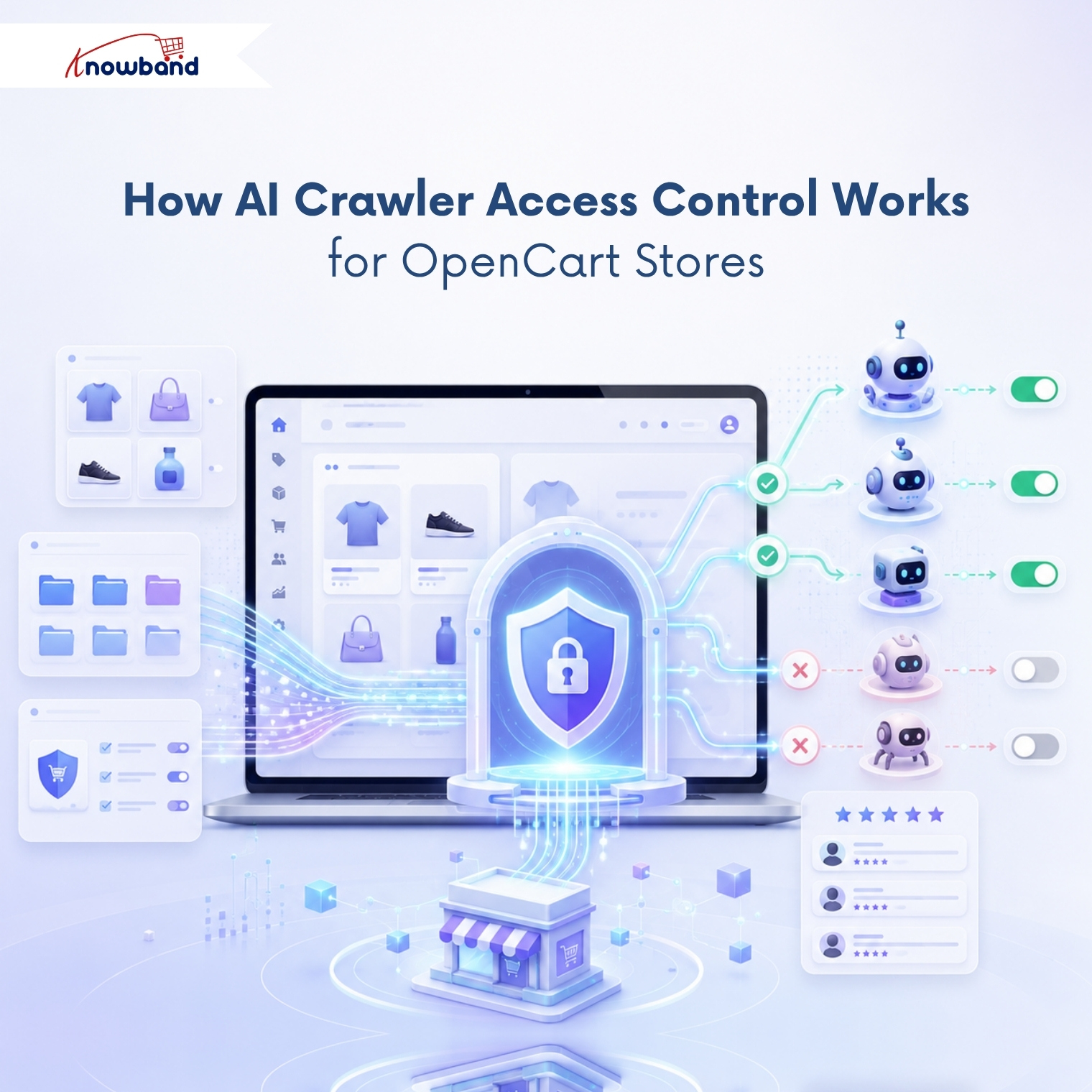
Not every AI crawler serves the same purpose, and controlling which ones access your store is a legitimate decision, not just a technical detail. The extension’s crawler settings allow admins to independently enable or disable five specific bots: GPTBot (OpenAI/ChatGPT), DeepSeekBot, Google-Extended (Gemini’s dedicated crawler, separate from Googlebot), PerplexityBot, and Anthropic-AI (Claude).
The OpenCart Extension for AI crawler access control is useful for merchants who want to appear in ChatGPT product recommendations but haven’t yet evaluated DeepSeek’s platform relevance for their market, or for stores that want to control exposure incrementally rather than opening to all AI crawlers simultaneously. Each bot serves a different platform and a different audience, and treating them as a single undifferentiated group ignores that distinction.
This granular control also reduces the risk of AI hallucination around your store’s specific product details. When an AI model has no clean, authoritative source for a product’s specifications or a store’s return policy, it generates a response based on similar or cached content, which can mean inaccurate information reaching a customer who was already close to a purchase decision. Accurate AI-generated answers depend on clean AI-accessible data, and clean data requires deliberate file structure.
Content Filtering: Choosing What AI Systems See About Your Store
The OpenCart AI product discovery Extension includes content filtering that gives admins granular control over what appears in the generated file. Rather than exposing the entire catalog, merchants can select active products only, specific featured products, chosen categories, and particular CMS pages, shipping policies, FAQs, and store information, while excluding internal or draft content.
This selectivity matters for two reasons. First, including every page without filtering often means AI models receive fragmented or low-quality data that dilutes the clean product information. Second, not all CMS pages are intended for external reference; draft policies, internal promotional pages, and temporary content don’t belong in a file that AI platforms will read as a source of truth about your store.
The file customisation options extend this further. Section-level fields allow admins to add instructional context before and after the store description, product section, category section, and CMS section, essentially annotating the file for AI readers with explanations of category naming conventions, variant relationships, or policy structures. AI systems read this context when generating responses, which means a merchant who adds clear structural notes gives AI models a better chance of representing the store accurately.
What the Gap Costs OpenCart Stores That Don’t Address It
Organic search volume for commercial queries is projected to fall 25% by 2026 as AI answer engines handle more product discovery queries directly. The traffic that still reaches product pages through AI referrals converts at measurably higher rates than traditional organic traffic, because users arriving from an AI recommendation have already received a pre-qualified answer rather than a list of options to evaluate.
OpenCart stores that rank well in Google but haven’t structured their content for AI crawlers exist in a gap: visible to traditional search, but partially or entirely invisible to the AI platforms now directing high-intent product discovery. The two visibility types are not interchangeable, and maintaining strong traditional SEO doesn’t close the AI discoverability gap on its own.
An OpenCart llms.txt generator extension is the infrastructure layer that closes this gap. No module can guarantee placement inside a specific AI answer, and the llms.txt specification remains a community proposal rather than a ratified standard, but it lowers the structural barrier for AI crawlers that do read it, and it ensures that when they do, they find clean and accurate data rather than presentation noise.
Why Addressing This Now Rather Than Later Has a Practical Advantage
In May 2026, Google added an llms.txt check to Chrome Lighthouse’s “Agentic Browsing” audit, a signal that the file format is moving toward broader institutional recognition regardless of its current specification status. The OpenCart merchants who implement this infrastructure now do two things simultaneously: they make their catalog more legible to AI systems that already crawl for content, and they position their store correctly for the moment when AI-driven product recommendation becomes a standard part of how purchases are initiated.
For OpenCart store owners who’ve handled traditional SEO and are now looking at AI search as the next discoverability channel, Knowband’s extension provides the most direct path to addressing both the file generation and the crawler management from a single back-office configuration, without custom development or manual file maintenance.
The OpenCart AI product discovery Extension is the infrastructure piece that bridges what your store already has in Google-visible content and what AI platforms need to recommend it accurately.


